

Choosing a proprietary trading firm is a decision that deserves as much attention as developing a trading strategy. An attractive challenge fee or a large advertised account can look appealing, but neither tells you whether the firm’s rules fit your approach, how much room you have to absorb losses, or what conditions apply when you request a payout.
The most effective way to compare providers is to examine their programs against the same practical questions. You should understand the evaluation process, drawdown calculations, permitted trading methods, available instruments, and conditions that apply after passing.
Several firms are worth considering, but each has a different focus. FTMO is known for its structured evaluation process, The5ers offers several program models, FundedNext provides different challenge formats, and futures-focused providers such as Topstep serve a more specialized market. Leofins is another option for traders comparing multi-asset programs.
Before looking at the ten questions, here is a shortlist of firms to investigate, with the main reason each may be relevant to a particular trader.
Prop Trading Firms Worth Comparing
1. FTMO — Best for a Structured Evaluation Process
FTMO is an established option for traders who prefer a clearly defined challenge with documented trading objectives. Its evaluation models have specific profit targets and risk limits, allowing traders to assess whether their strategy can operate within the account’s boundaries.
Main advantages:
- Established evaluation framework with defined objectives.
- Multiple challenge models to compare.
- A range of forex and CFD instruments.
- Published rules that traders can review before enrolling.
Best suited to: Traders who want a structured evaluation process and are comfortable adapting their risk controls to the selected model.
2. The5ers — Best for Comparing Different Program Structures
The5ers offers several trading programs with different evaluation and progression models. This gives traders an opportunity to compare structures rather than relying on one standard challenge format.
Main advantages:
- Multiple programs aimed at different trading preferences.
- Options for traders comparing evaluation and account-development structures.
- Forex and CFD-oriented offerings, alongside a separate futures program.
- Program-specific rules that can be assessed against a trading plan.
Best suited to: Traders who want to compare different challenge structures and find one compatible with their trading frequency and risk management approach.
3. FundedNext — Best for Comparing Evaluation Models
FundedNext offers several challenge formats, making it a useful candidate for traders who want to compare different evaluation arrangements. The important distinction is that rules can vary by product, so the exact model matters more than the company name alone.
Main advantages:
- Different evaluation models to compare.
- Programs that may appeal to traders with different preferences for challenge structure.
- A range of supported markets depending on the selected offering.
- An opportunity to compare evaluation objectives and payout requirements across models.
Best suited to: Traders who want to evaluate multiple challenge structures before committing to one program.
4. Leofins — Best for Comparing Multi-Asset Options
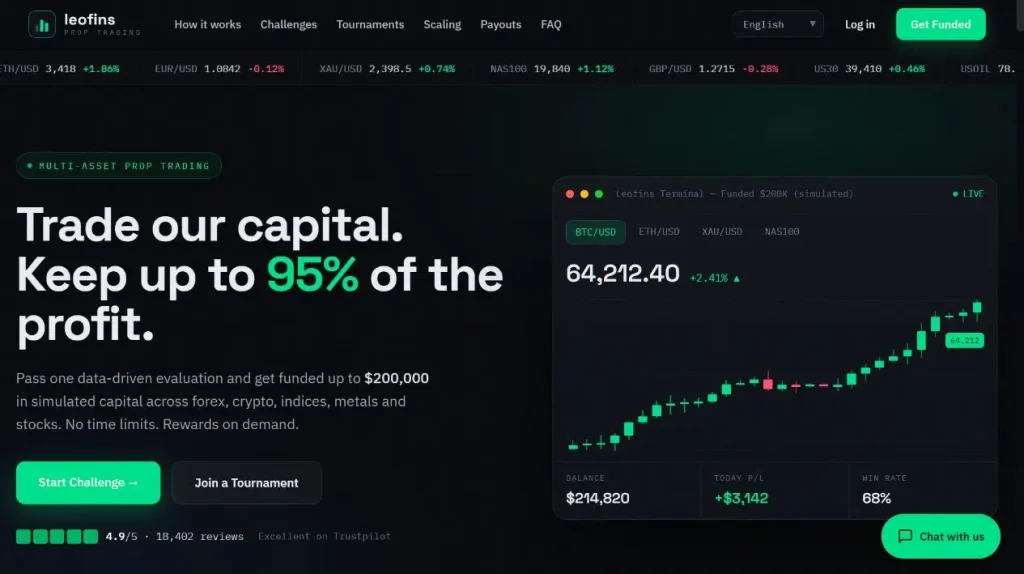 Leofins is worth considering for traders who want to compare access to multiple asset classes and look beyond a futures-only program. Its listed offerings cover markets such as forex, cryptocurrencies, indices, metals, and stocks, although availability depends on the selected program.
Main advantages:
- Multi-asset options for traders comparing different markets.
- A choice of programs to evaluate against individual trading requirements.
- Entry-level offers that may appeal to traders who want to compare initial challenge costs.
- An alternative to consider when assessing instrument availability and evaluation rules together.
Best suited to: Traders who have tested strategies across several supported markets and want to compare multi-asset evaluation options.
Traders can review Leofins’ current offerings at https://leofins.com and check the exact instrument list, fees, evaluation requirements, and payout conditions before choosing a program.
5. Topstep — Best for Futures-Focused Traders
Topstep is a futures-oriented prop trading provider. Its focus makes it particularly relevant to traders whose strategies are designed around exchange-traded futures contracts rather than forex or CFD instruments.
Main advantages:
- A futures-specific evaluation environment.
- Programs built around futures trading objectives.
- A relevant option for traders who understand contract sizing and tick-based risk.
- Rules that can be compared against a futures trader’s existing risk plan.
Best suited to: Traders who specialize in futures and want an evaluation built around that market.
6. MyFundedFutures — Another Futures Program to Consider
MyFundedFutures is another provider worth comparing if you trade futures. Different plans may have different drawdown calculations, evaluation objectives, and payout requirements, so traders should examine the individual program rather than assume all plans operate alike.
Main advantages:
- A futures-focused offering.
- An additional provider to compare when evaluating contract limits and risk models.
- Program choices that can be assessed against different trading routines.
Best suited to: Futures traders who want to compare more than one provider before purchasing an evaluation.
These firms serve different needs, so the shortlist should not be treated as a universal ranking of trading quality or payout reliability. The most appropriate option depends on the exact program, current rules, and the trader’s own methodology.
The Ten Questions to Ask Before Choosing a Prop Firm
1. Which Markets and Instruments Can I Trade?
Start with the instruments you already understand. Some firms concentrate on forex and CFDs, while others specialize in futures. Multi-asset providers may offer a combination of currencies, indices, metals, stocks, and cryptocurrencies.
The difference matters because instruments have different trading hours, volatility characteristics, contract specifications, and position-sizing requirements.
A futures trader needs to understand tick values, contract limits, and the relationship between stop distance and monetary risk. A forex trader may prioritize spreads, lot sizing, news restrictions, and overnight holding conditions. A crypto trader should confirm which assets are available and whether the account permits trading at the times their strategy requires.
Before enrolling, verify that the exact program supports your preferred instruments. Do not assume that every account from the same firm provides access to the same markets.
If you already have a tested strategy for one or two instruments, a specialized program may be sufficient. If you have independently tested several strategies across different asset classes, a multi-asset account may offer more useful flexibility.
2. How Is Drawdown Calculated?
Drawdown rules determine how much room an account has to absorb losses. A firm’s advertised account size can be misleading if the actual permitted loss is too small for your trading method.
A static drawdown generally remains tied to a fixed reference point. A trailing drawdown may move upward as the account reaches new highs. Depending on the program, it may be updated intraday or calculated using end-of-day results.
Daily loss limits introduce another layer of complexity. You need to know what counts toward the limit, when the daily calculation resets, and whether unrealized profit and loss affect the account’s status.
Consider a strategy that allows profitable positions to retrace before closing. Its performance may be affected differently by a trailing threshold than by a static limit. A strategy with several simultaneous positions can also approach a loss boundary faster than expected if those positions move against the trader together.
Before paying, write down the daily loss limit, overall maximum loss, calculation method, reset time, and any rules affecting withdrawals or account growth. Then compare those conditions with your strategy’s historical drawdowns.
A suitable program should leave enough room for ordinary market fluctuations without encouraging you to take excessive risks.
3. What Are the Evaluation Requirements?
Evaluation programs can differ in the number of stages, profit targets, minimum trading days, and completion deadlines. These requirements affect how naturally your strategy fits the challenge.
A trader who takes multiple intraday setups may be comfortable with a program requiring activity across several days. A swing trader who waits for specific market conditions may need a longer period to reach the same target.
Ask the firm:
- How many evaluation stages are required?
- What is the profit target for each stage?
- Are minimum trading days required?
- Is there a completion deadline?
- Are there inactivity rules even if the evaluation has no fixed deadline?
FTMO, The5ers, and FundedNext are useful examples to compare because their different program models may suit different evaluation preferences. However, the rules of one product should never be assumed to apply to another product from the same company.
Estimate how long your strategy would take to reach the target using historical performance across both favorable and difficult market periods. If the challenge encourages you to trade more frequently or increase risk beyond your normal plan, reconsider whether it is suitable.
4. Which Trading Methods Are Allowed?
A firm may restrict certain trading methods even when the relevant instruments are available. Policies can cover automated systems, expert advisors, copy trading, news trading, high-frequency execution, overnight positions, and weekend holding.
If you rely on automation, check whether your particular system and execution method are permitted. If you trade around economic announcements, confirm the firm’s news policy. If you copy trades between accounts, verify whether that arrangement is allowed.
The details may also differ between evaluation and funded stages. Permission to use a particular strategy during a challenge does not necessarily establish that the same conditions apply after passing.
Read the official rules instead of relying on a general marketing statement. If an important restriction is ambiguous, ask for clarification before purchasing the challenge.
5. What Is the Total Cost of the Challenge?
The initial fee is only one part of the potential cost. Depending on the program, you may also need to consider reset fees, recurring charges, platform-related costs, or other expenses specified in the terms.
Refund conditions deserve particular attention. A fee refunded after a qualifying milestone is different from one that is refundable under all circumstances. Check the precise eligibility conditions rather than assuming that passing automatically guarantees a refund.
A lower-priced challenge may be attractive, but it is not necessarily better value if its drawdown rules are incompatible with your strategy. Conversely, paying more does not guarantee a better fit.
Compare the total cost with your budget and decide in advance how much you can afford to spend on an unsuccessful attempt. Avoid purchasing repeated challenges simply because the initial price appears manageable.
The objective is to choose a program you can approach responsibly, not to minimize the entry fee at the expense of suitability.
6. How Do Payouts and Profit Splits Work?
An advertised profit split does not tell you the whole story. You also need to understand when payouts become available, how frequently withdrawals can be requested, and whether additional requirements apply.
Check the minimum payout amount, withdrawal schedule, eligibility conditions, and any consistency requirements. Find out whether the profit split changes under different account stages or program options.
This matters because trading strategies can generate profits unevenly. A strategy that relies on a few strong trading sessions may be affected by a consistency rule that limits the contribution of the best day. A strategy with smaller, more regular results may interact with such a requirement differently.
Also distinguish between passing an evaluation and becoming eligible to withdraw profits. These are separate milestones and may have different rules.
Before enrolling with FTMO, The5ers, FundedNext, Leofins, or any other provider, review the payout terms attached to the exact program. Do not compare companies using only their highest advertised profit split.
7. Does the Platform Support My Trading Workflow?
Platform compatibility can influence order execution, risk monitoring, chart analysis, and automation. If your strategy depends on particular indicators or order types, switching platforms may require changes that affect your results.
Confirm which platform is available for the selected account and whether it supports your preferred instruments. Check the permitted use of automated tools, the availability of relevant order types, and whether you can access the reporting data needed to evaluate performance.
For futures traders, contract specifications and execution tools are particularly important. Forex and CFD traders may have different requirements for charting, position sizing, and order management.
Do not assume that every program from one firm uses the same platform. Compare the actual product you intend to purchase and make sure you can operate it comfortably before starting an evaluation.
8. What Happens After I Pass?
Passing a challenge does not mean that all requirements disappear. The next account stage may have different operational procedures, payout conditions, risk limits, or ongoing restrictions.
Ask what changes after passing and which evaluation rules remain in effect. Understand how the account is activated, what documentation may be required, and what conditions can lead to a breach or account closure.
You should also understand the nature of the account arrangement. A large nominal account balance does not necessarily mean that the trader has received that amount as personal capital. Many prop firm evaluations operate in simulated environments, and the precise arrangement depends on the provider and program.
The5ers, FTMO, Topstep, and other firms have their own account structures and progression procedures. Compare those terms directly rather than assuming that all providers use the same model.
Passing should demonstrate that you can follow the rules consistently. It should not be a reason to increase risk or abandon the process that helped you complete the evaluation.
9. Are the Rules Transparent and Is Support Accessible?
Before paying, establish whether the provider publishes a clear rulebook and makes the conditions of each program easy to understand.
Look for detailed explanations of drawdown calculations, breach conditions, trading restrictions, and payout requirements. If the information on a promotional page differs from the formal terms, ask which rules govern the account you intend to purchase.
Support quality is also important. You may need help interpreting a restriction, understanding an account calculation, or resolving a payout question. Check which support channels are available and whether the provider gives clear answers to program-specific questions.
Independent reviews can offer useful context, but isolated positive or negative experiences should not be treated as definitive proof. Look for detailed, recurring patterns and distinguish between documented experiences and unsupported claims.
Finally, check how rule changes are communicated. You should understand which terms apply to your account and whether changes may affect existing participants.
10. Does the Firm Fit My Trading Style?
The final question brings all the others together. A provider may offer competitive fees, several markets, and appealing payout terms, yet still be unsuitable for your strategy.
Write down your essential requirements:
- Your preferred instruments and trading sessions.
- Typical number of trades per week.
- Average risk per trade and historical drawdown.
- Normal holding period.
- Use of automated systems or trade copying.
- Expected time needed to reach the evaluation target.
- Budget for challenge fees and possible resets.
Compare these requirements with the program’s rules. If you would need to increase your risk, take low-quality setups, or change your entry criteria to pass, that program may not be the right choice.
This is where the differences between firms become useful. FTMO may appeal to traders who prefer its evaluation framework; The5ers may suit someone comparing different program structures; FundedNext offers multiple models to assess; Topstep and MyFundedFutures are relevant to futures-focused traders; and Leofins is worth considering when comparing multi-asset offerings.
The best fit is the program that allows you to follow your tested strategy while staying comfortably within the rules.
How to Make the Final Decision
Do not try to compare every available prop firm at once. Start with three or four candidates whose markets and account structures fit your needs, then evaluate them using the ten questions above.
First, eliminate programs that do not support your instruments, platform, or trading method. Next, compare drawdown rules and evaluation requirements. Then review the payout conditions, total cost, and transparency of the terms.
Keep the focus on practical compatibility rather than marketing claims. A large advertised account does not automatically provide more usable risk capacity, and a high profit split does not guarantee that you will qualify for a withdrawal.
A sensible shortlist might include FTMO, The5ers, FundedNext, and Leofins for traders comparing different evaluation and multi-asset options, with Topstep or MyFundedFutures added if futures trading is central to the strategy. The final choice should depend on the exact programs and current rules, not on brand recognition alone.
Prices and conditions are current as of October 2026.
Risk disclaimer: Proprietary trading evaluations involve financial risk. Challenge fees may be lost if an evaluation is unsuccessful or program rules are breached. Simulated trading results and funded-program performance do not guarantee future income. Review the current terms carefully and never spend money you cannot afford to lose.







Залишити відповідь